For me, it is almost exactly 52 years since I first watched Star Trek as a 6 year old. My initial memory is of being scared by the aliens. Of course, I gradually fell in love with it and its credo has had a not insignificant impact on my life; second, perhaps, only to my Jewish faith. As a fan, I, of course, enjoyed the subsequent spinoffs, notably, as most would agree, TNG.
As an adult, a physician and scientist with some experience in writing non-fiction science, I admire, greatly, the imagination and creative juices of not only the Star Trek writers but others in the realm of science fiction and fantasy. Some of these, Roddenberry, Tolkien, Bradbury, Clarke and Asimov (just to name a few) are etched in my memory as in a cathedral to greatness.
STD, though I use that moniker not at all casually, makes me appreciate that greatness of imagination even more so. We have talents producing science fiction and films, today, but they pale in imagination compared to that previous generation. I am not a huge fan of the term, "the greatest generation", but, perhaps, it plays here.
What prompted the creators and writers to go back to the decade before TOS? Lack of imagination. Why did they feel the need to bring new ST tech and new, real world CGI back to the time before? "We will never use holographic projectors on the Enterprise again", said no real captain anywhere. Literary device to cover lack of imagination. Why was it necessary to tie Burnham to Spock? Could she not have stood on her own as an ST lead? Why create a war with the Klingons (season 1) that did not have reference in any other timelines. Why reinvent the Klingons appearance rather than create something new? Even the concept of the Terran universe taken from TOS: Mirror. Why introduce even more technology into a timeline where we now it doesn't exits? The red angel suit: ironman. Even some of Burnham's kneeling positions are taken from Ironman. Why? Lack of imagination. The finale? A Star Wars (gasp!) look alike. Time crystals? Really? Can you spell Deus ex machina? (What's wrong with a good old hyperbolic trajectory toward the Sun?)
Don't get me wrong, there some moments of goodness but few of greatness. I did like Like and number 1. But if you wanted to do a TOS Enterprise prequel you'd had to have focused on story and not tech. Can't do that? Then don't. The spore drive? Good. But it doesn't fit in the timeline so a distraction. I could go on.
The worst part is that, at the end of season 2, we now know that the abuse of the TOS timeline was just a setup for season 3. Well, that, for me, will be only the first test of their creativity and imagination. And even then, they will have to convince me that couldn't have launched season 3 without a more creative introduction.
Thursday, April 18, 2019
ST: Discovery: Not a fan


Wednesday, October 10, 2018
New England and the Canadian Maritimes - 2018 Foliage Run - Day 6 - 267 miles - Bar Harbor to Moncton, NB
3-179-9-Canada-1-2. Pics and vids to follow.
Monday, October 8, 2018
New England and the Canadian Maritimes - 2018 Foliage Run - Day - Portland to Bar Harbor, 160 miles

The theme for today is, "chiiiilllly". The bike says the air temp this morning is 50°F! I say, "Yikes!" I am wearing my riding boots, heavy wool socks, long underwear, insulated jeans, wicking undershirt and underpants, heavy sweater and my Guideware jacket with a balaclava. Actually, with all this, I am quite comfortable. The temp slowly rises to 55 and we end the riding day at 4 PM at 57. Having dealt with the temp, the riding is otherwise spectacular! We leave Portland on 295 North but pick up Rt. 1, "coastal route" at Brunswick. We continue up the coast to Bar Harbor. Again spectacular seascapes and foliage. Each section of the road is better than the last. The small towns of Rockland and Rockport and Camden are beautiful. Lots of great pictures and video to follow.
Sunday, October 7, 2018
New England and the Canadian Maritimes - 2018 Foliage Run - Day 3 - Sharon to Portland, ME

Our luck is running good. Sunday starts out overcast but warm; over 70. Rain is forecast for later in the day, but for now, the heavy shirt is enough. We ride toward and around Boston on 95. It is pleasantly warm. There is remarkably little traffic and it is one of the most pleasant passages around Boston I have yet to experience. We are in Portsmouth, NH before we know it.
Once over the Piscataqua bridge into Maine, we leave 95 for 103 and the Maine coast. This is the quintessential tour of the SE Maine coast and Rivka is enjoying the sights, sounds and especially smells along the way.
We stop at the very scenic and photogenic, Fort McClary State Historic Site. A lovely place to get the feel of Maine.
As it is a long weekend, the small towns along the way are filled with tourists queueing in the crab shacks and fish markets for their lobster rolls. The tang of the sea and seaweed is all around us as is a fine mist. It remains warm enough to ride in shirt sleeves. Maine-iacs from all over the east coast are in wet suits surfing and boogey-boarding in a fairly rough chop. It is a classic day at the shore.
As we move north, the foliage is presenting itself in bright patches of red, orange, yellow and green. Wenlook forward to more foliage to come. The pictures and videos will be spectacular (to follow). This after the more muted early fall colors of Massachusetts and New Hampshire.
We continue up the coast to Kennebunkport (no sign of 41) and on to our hotel in S. Portland. Aftee a brief rest, we tour the Old Port neighborhood which has been beautifully gentrified. We end our evening with our picnic dinner at Loring Memorial Park overlooking Portland's back cove. A great day and a great ride. 141 miles: Sharon to Portland. Tomorrow, on to Bar Harbor.
New England and the Canadian Maritimes - 2018 Foliage Run - Days 1&2

We begin on a cloudy and cool morning in Vestal. Last minute packing is done and we head out. I am riding Xray2, the GoldWing. I have the luxury, this trip, of my companion in her SUV. It is about 55 degrees. I am comfortable in my insulated jeans, heavy shirt and insulated Cabela's Guidewear jacket. We advance up 81 North out of Binghamton picking up 88 to the Northeast. Halfway to Albany we transition from partly cloudy to partly sunny arriving at mostly sunny as we cross into Massachusetts on the Mass Pike. The foliage along 88, although spectacular as scenery, has yet to change color much. We will have to see if this changes on the way back. The ride through Massachusetts is pleasant though we hit inevitable traffic that makes us commit to the Connecticut route for subsequent trips. We arrive tired but satisfied in Sharon for a visit with the folks. Saturday will be a rest day with them. 331 miles: Vestal to Sharon.
Wednesday, December 20, 2017
EMR/EHR Interoperability: The Missing Link
There
has been much wailing and gnashing of teeth about the lack of interoperability
of our electronic medical and health records (EMRs and EHRs). Some of this
frustration can be directed toward a fundamental flaw of the American
Healthcare System; lack of a national patient identifier. There is, however,
another culprit whose head struggles to rise above the noise, hype and politics
of interoperability: lack of a payload for interoperability.
As a radiologist and imaging
informaticist versed in imaging interoperability based primarily on the Health
Level 7 (HL7) and Digital Imaging and Communication in Medicine (DICOM)
standards and the Integrating the Healthcare Enterprise (IHE) integration
profile choreography of those two standards, I am flummoxed that the rest of
health care does not have the interoperability that we enjoy in Imaging. We have
a patient centered “export all” button and the rest of healthcare does not.
This
functionality has three important repercussions for health care. You can go to
any digital medical imaging department in the world, and with patient
consent ask for all the imaging studies of that patient. In the worst
case scenario, you will be given a set of CDs; in the best case, you
will be directed to an on-line service provider. Not only will those CDs
contain, most often, an end user image viewer with a standardized user
interface but after appropriate cross-institution, patient identity management,
you can import these studies into a subsequent picture archive and
communication system (PACS) for use as comparison studies in the clinical
setting.
Of interest is
the fact that radiology reports fall somewhere in between medical images and
EMR results. Radiology reports are, in fact, often included, on CDs when image
studies are exported. They are, however, less well formally defined, there is
some variability in both their presence and the ability to import them into
electronic medical record systems in a computable fashion.
The second
repercussion of having all this data available in a standard format is that it
is available for image processing and machine learning. All of the major image
processing environments, proprietary or open, are able to process these medical
images in any number of ways.
The third
repercussion of this function of DICOM and IHE is that you can migrate imaging
data, in bulk, from one PACS to another and this happens routinely. PACS
systems are still evolving functionality and after 7 or 10 years of service
(since PACS have been in service now for almost 25 years!) it is not uncommon
for an institution to choose a new PACS and migrate all of the image
data from the previous system to the new one. It is not a perfect or painless
process due, typically, to a bit of data uncleanliness that builds up over the
years, but it is insightful, straight forward, vendor supported and achievable.
It happens, without much fuss every day.
None of this is
the case for EMR data. The unit of exchange in what we call EMR interoperability
(or the lack thereof) is not patient data but rather abstraction of patient
data into Clinical Document Architecture (CDA) documents. The name, itself,
positions it as nothing more than paving the cow path of the old three ring
patient information binder and its paper documents. The aggregation of all of a
patient’s CDA documents from all of a patient’s providers by no means
represents all of the medical information about the
patient.
CDAs are
designed, from the get go, to be ‘human readable’ yet they are, for the most
part, illegible. HL7 and the Office of the National Coordinator for Health
Information Technology (ONCHIT) had to sponsor a challenge last year, to
improve rendering of these documents. From a technology perspective, HL7 erred in
blending the human readable and machine computable in one document. Much of
modern computing is based on the model, view, controller (MVC) paradigm wherein
data, delivery and display are separate not the least of why is so that each
may be optimized.
Note that HL7’s
Fast Healthcare Interoperability Resources (FHIR) specification does not solve
this problem. FHIR defines modular resources that represent components of the
patient’s record. There is a mechanism for bundling resources and for getting
all available resources from a single system. Modular resources have not yet,
however, been defined to cover the complete breadth of patient data. They will
continue to be developed and released for years to come (as will CDAs).
Moreover, vendors are not required to implement any given set of modular
resources and, so, availability is and will be haphazard.So, neither the
patient’s complete collection of CDAs nor all their FHIR modular resources can
be used to develop a complete clinical picture of the patient. Nor can they be
used to develop a complete computable data structure of the patient. This
hampers the development of new computer applications in health care at a time
when the technology for doing so is burgeoning.
Equally
important, these collections also cannot be used to migrate patient data from
one EMR to the next. This lack of migration stifles innovation and competition amongst
EMR vendors. We want vendors to compete on novel ways of capturing, creating
and making use of patient data not on the basis of possession of patient data.
The lack of a clear, vendor neutral, affordable migration pathway traps the
customer steward of patient data in an untenable, expensive situation. We, in
Imaging, learned this important lesson decades ago; can you imagine, today,
having to purchase a proprietary interface from each imaging modality vendor?!
So, how do we
fix this interoperability problem once and for all? I suggest that HL7
International pause and take a breath. They are perfectly suited to develop a single,
new extensible markup language (XML) artifact, perhaps based on the Reference
Information Model (RIM), which can be used to instantiate all of a patient’s
EMR content at a given point of time. Let’s call this the XMR for ‘exportable
medical record’. This XMR artifact, though geek readable, does not have to be
human readable (and I say that in the nicest way possible). Let the systems
that receive, aggregate and process these new artifacts compete on how best to do
so.
The problem of
the lack of interoperability in health care information systems can be solved as
has been done for decades in subdomains like Imaging. This new XMR payload
artifact could be transported by any number of proprietary, IHE or FHIR
transport mechanisms for any number of purposes. At any point in time, a
patient could go to their provider and ask for their XMR (perhaps delivered on
a thumb drive). More importantly, using existing exchange and patient record
locator services EMRs could query their peers for a patient’s XMRs and these
could be aggregated and incorporated, as structured data, into the local EMR.
The collection of XMRs could be used to present more complete clinical
information, drive the development of novel computer processing of patient data
and liberate patient data from proprietary silos where it is now trapped. The
ONCHIT could then live up to its name and mandate the use of this XMR artifact
and the ‘export all’ button.
Friday, August 25, 2017
Photos From The Great Eclipse Ride (TGER) 2017, Elkton, Kentucky, August 21, 2017
OK, here are the pictures from the eclipse. We rode down from Indiana into Kentucky trying to get as far into the zone of totality as possible before the Eclipse started. I used the Eclipse2017.org app to see where we were with respect to totality. We stopped in Elkton, KY which was not to far from the center line. The town looked quite prepared. The town square had a festive look to it with a small crowd congregating about the Town Hall. Everyone was very friendly and having a great time. (And it was a sincere good time since they are a dry county!) There was music piped in for the occasion.


Note: All photos of the sun/eclipse were taken with my Google Nexus 6 phone! (I fried my GoPro, but that is another story for another day). I used the Manual Camera App from Geeky Devs Studio (a great app). This app lets you adjust all of the functions you would find on a 35mm camera (ISO, F-stop, shutter speed, focus, etc.). I used an ISO/CE certified Silver-Black Polymer Sheet solar filter from Thousand Oaks Optical over the lens. I cut a square from the sheet and placed it inside my phone case wedging it over the lens so it was held in place. The morning of the eclipse, I did a test shot of the sun rising over our breakfast spot.
 For the actual eclipse, before totality, I set the ISO very low, to about 50, otherwise the glare/flare from the remaining sun 'blossomed" on the image. I tried to keep the shutter speed around 1/250 so as to avoid motion. So the early eclipse looked like this:


 I was only disappointed that I didn't get the 'diamond ring' shot either coming or going.
 I used the 4X optical zoom for all the photos.


Note: All photos of the sun/eclipse were taken with my Google Nexus 6 phone! (I fried my GoPro, but that is another story for another day). I used the Manual Camera App from Geeky Devs Studio (a great app). This app lets you adjust all of the functions you would find on a 35mm camera (ISO, F-stop, shutter speed, focus, etc.). I used an ISO/CE certified Silver-Black Polymer Sheet solar filter from Thousand Oaks Optical over the lens. I cut a square from the sheet and placed it inside my phone case wedging it over the lens so it was held in place. The morning of the eclipse, I did a test shot of the sun rising over our breakfast spot.


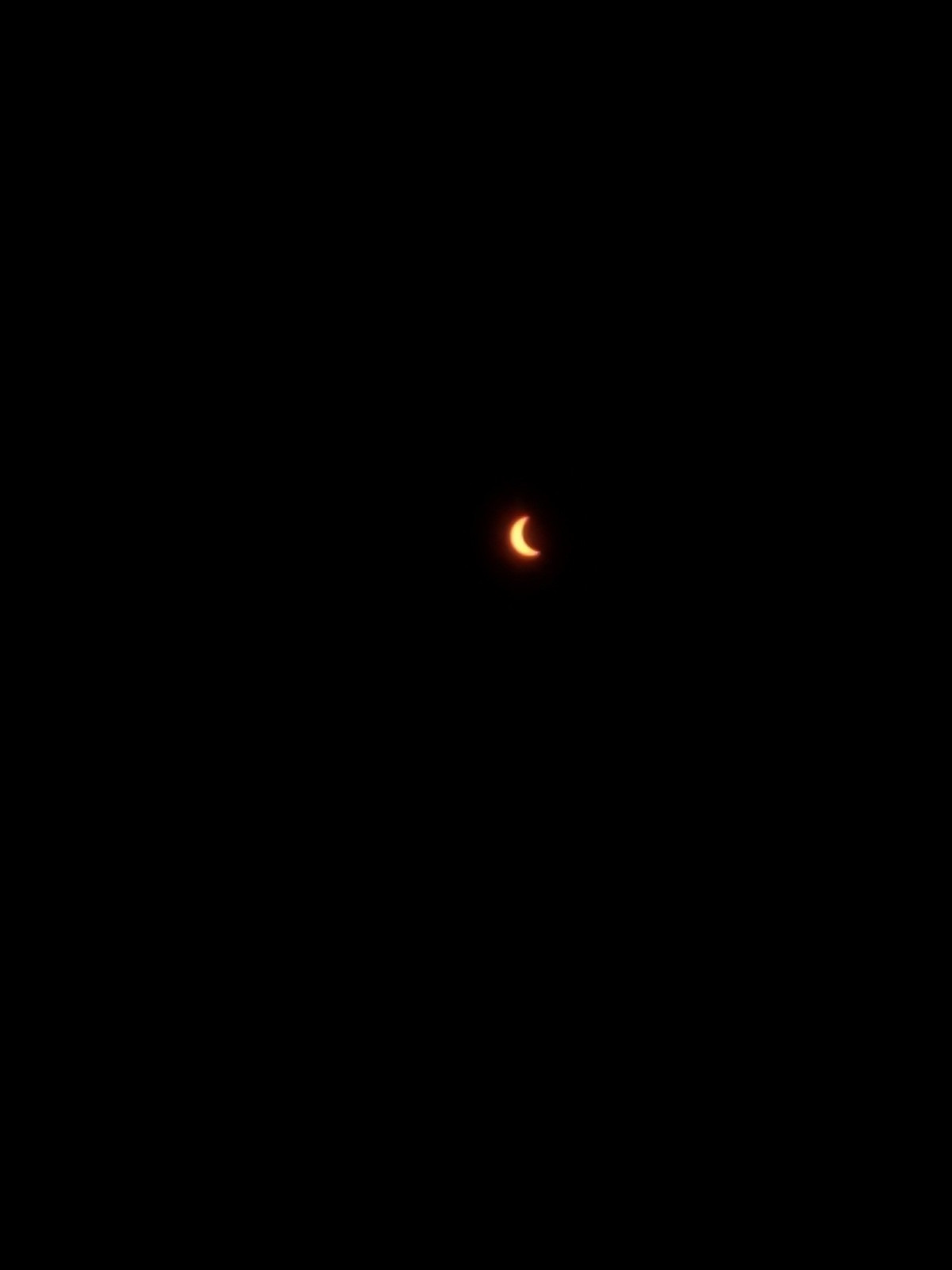

As the sliver of sun got progressively smaller, I progressively adjusted the ISO up.


For this next shot, I zoomed out to get the eclipse and, I believe, Venus, just as a point of light in the lower right.

My friend Aaron, had taken a few pictures of the surrounds during totality:


And I managed to remove my filter and grab one as well.

Then, I reversed the progress as the moon withdrew:


Then we went to the local post office to get our envelopes and first day covers canceled:


Overall, a great ride and a great eclipse experience. Planning is under way for 2024 though we won't have to travel far in upstate NY for totality!
TGER2017 Homeward Bound (II)
"Home where my thought's escaping,
It is another beautiful day. I have Skyline Drive to myself. Very little traffic. The way is silent; the views spectacular. I am meandering at a pace of 35-40 miles per hour. I come around a corner and there is a fawn by the side of the road; undisturbed by my presence. It is cool at over 3000 ft elevation; I am wearing a heavy shirt and my light jacket. But it is an enjoyable chill that accompanies the one running down my spine from the beauty of the moment. This is one of the East Coast's old ladies of roads. I am left with a desire to return and explore on foot.Home where my music's playing,Home where my love lies waitingSilently for me."
The rest of trip is anti-climactic. I slab up 81, one of my least favorite highways. Always an accident or construction to cram traffic into a miles long, single lane delay. Tonight, old 81 did not disappoint; we had both, several times over the course of 200 miles across the state of PA. But, in the end, all road lead home, in this case, not just to my "love lying waiting" but to a steak dinner with all the trimmings. What better way to end the TGER2017.


TGER2017 - Homeward bound (I)
As Mr. Burns (no, not that one), said, “The best laid schemes o' mice an' men / Gang aft a-gley.” It looks like the road to Charleston is paved with stormy weather. So, I turn the wheels northeasterly and begin the journey home. Last night we noted the tail of a bank of storms passing through the mid-Atlantic all the way up the coast. I will slip just west of them. The line of the front accompanies me on the right the majority of the day, but I am dry. I have dodged the weather once more. I take 11W north. Another enjoyable country road. The national forests are to my right. Then I join 219 for a bit. This is the same 219 that I took down on Day 1 next to the Allegheny National Forest. Interestingly, as I was riding the 11, I noticed some debris on the road. A sheriff that I had just passed lit up his lights. I was not going that fast. I pull over at the next driveway. He is slow to get to me. When he does, he apologizes. "I only turned on my lights so as to safely remove the debris. I didn't mean to pull you over." It turns out he is a biker, too. We had quite a good chat about riding, the Cherohela, Dragon's Tail and, surprisingly, he had high recommendations for 219. This is a road that needs exploring!
But the highlight of the day were the roads through the Monongahela National Forest and the Washington and Jefferson National Forest. From the look of the trees on the map, they look like the same forest but they span the WV and VA border. On the WV side, the road to beat is the 92, "The Pocahontas Trail". Spectacular riding. I then took the 250 across to the VA side and it, too, is great. Several challenging, pronounced, "harrowing", turns. Great fun. I should have continued 250 to 64 and the base of Skyline Drive. Instead, I followed Google Maps on a meander to Harrisonburg, VA and the upper segment of the Drive, for tomorrow. Don't get me wrong, it was a great meander.

But the highlight of the day were the roads through the Monongahela National Forest and the Washington and Jefferson National Forest. From the look of the trees on the map, they look like the same forest but they span the WV and VA border. On the WV side, the road to beat is the 92, "The Pocahontas Trail". Spectacular riding. I then took the 250 across to the VA side and it, too, is great. Several challenging, pronounced, "harrowing", turns. Great fun. I should have continued 250 to 64 and the base of Skyline Drive. Instead, I followed Google Maps on a meander to Harrisonburg, VA and the upper segment of the Drive, for tomorrow. Don't get me wrong, it was a great meander.

Monday, August 21, 2017
TGER2017 Elkton, Kentucky - Success
We rose, early, to a clear sky just lightening to the east. The cool and the dew gave us just the right frisson of anticipation. We rode south from the Brown County In heading for Kentucky and the zone of totality. 46 was a lovely,winding road through the woods the enjoyment of which was just slightly reduced by an unexpected amount of traffic. An omen of things to come? Fortunately not. We continued on 37 South an enjoyable road, in its own right, that led through the Hoosier National Forest. By now, the heat was building as was the anticipation. We knew we were approaching the zone. We crossed the Ohio River into Owensboro, Kentucky past the Glenmore Distillery. We meandered south going further into the zone passing occasional small gatherings waiting for the eclipse.
We settled on the town of Elkton very close to the centerline of totality. It seemed like the entire town was gathered around the square. There was music piped in from somewhere (a lot of "Here Comes the Sun", etc.). Everyone in town was wearing Eclipse t-shirts,many promoting local businesses. After sandwiches and several bottles of water (ironically, in the heart of burbon country Elkton is is Todd County which is dry!), we found a corner in the shade to watch and wait. We took a bunch of photos that will be added when I have a better connection. The moment of totality came quite suddenly with a great cheer and oohing and aahing from the small crowd. The feel of the situation was wierd. It is twilight with this unusual ring hanging in the sky. The light is a strange color not quite black and white. Both Jupiter and Venus

were easily visible. More photos. Calm. And then, boom, another shriek from the crowd as the retreating diamond ring appears and totality is over. We watch through the filters as the moon retreats. We then sauntered to the post office to have them cancel our first day covers. They were happy to do so with a special cancel they had ordered. We finished another 20 minute ride to our hotel just over the line in Tennessee. Met many friendly people along the way each sharing their eclipse story. I am sure there are many more to come.
We settled on the town of Elkton very close to the centerline of totality. It seemed like the entire town was gathered around the square. There was music piped in from somewhere (a lot of "Here Comes the Sun", etc.). Everyone in town was wearing Eclipse t-shirts,many promoting local businesses. After sandwiches and several bottles of water (ironically, in the heart of burbon country Elkton is is Todd County which is dry!), we found a corner in the shade to watch and wait. We took a bunch of photos that will be added when I have a better connection. The moment of totality came quite suddenly with a great cheer and oohing and aahing from the small crowd. The feel of the situation was wierd. It is twilight with this unusual ring hanging in the sky. The light is a strange color not quite black and white. Both Jupiter and Venus

--
Sunday, August 20, 2017
TGER2017 Day 2: Cold to Hot
I see that the theme of this ride will be morning fog. I slept like a log right after dinner. That meant I was up to ride at 5 AM. It was clear and cool as I set out guided this time by solar photons reflected off Venus. The thermometer, at 5AM, said 63 but the riding felt like 53. I had my undershirt, my riding shirt, my heavy shirt ,my light jacket and the safety vest and was just comfortable. Every 100 miles I took a layer off until I rode into Indiana naked at 92° (I am exaggerating only slightly). But the morning ride through the fog laden mountains of West Virginia was quite refreshing especially as the sun rose (verb and color) behind me. This was not light tendrils of upstate NY fog, this was the real deal, a heavy blanket. I stayed at 35-40 mph for the first hour or so. I took mostly 50 West and then 32 West both labeled the Appalachian Highway. Nice enough roads through what is the heartland of America. Farms and small towns. Interestingly, this highway has intersections so you do about 60 then stop for a light every once in a while. Crossed the Ohio River into Ohio and continued straight West. I was mostly alone until I hit (and got lost in) Cinncinati. From there westward, fellow bikers everywhere. Another 400 miles under the belt. Tomorrow into Kentucky for the eclipse! Stay tuned.


Saturday, August 19, 2017
TGER2017 - Day 1 in the bag.
"Fog's rollin' in off the East River bank...." But it's not. Our fog is tendrils of cotton strewn amongst the hills that accompany the Susquehanna. With the sun rising behind me, the fog slowly lifts revealing the tree clad peaks of those hills. The road is empty and quiet. I make good time to my exit from the highway. From hone, the first leg is nearly due West. I join a new secondary road that neither I nor my bike has seen. It parallels the NY/PA border dancing from hill to farm and back again. I turn south at Bradford PA for a beautiful ride through the Allegheny National Forest. The urge to stop and explore is nearly insurmountable but my timeline does not permit. The forest is dark, cool and inviting, Clouds have come in and the radar hints at a pop-up storm so I put on the rain gear. False alarm as within a couple hours the clouds are much more friendly. In fact, its getting quite warm and I finish, sweating,in the high 80s here in WV. Tomorrow, it's, "Westward Ho!" to Indiana to meet Aaron.


The Great Eclipse Ride of 2017 (1)
As I wake, the sky is a crystal clear, deep, Rich azure the likes of which one rarely sees. I am chasing the sun for its eclipse but this morning, the rising sun is chasing me westward. Down through western PA to West Virginia. The XRAY2 photon is accelerated by those that follow me from the East.
--
Tuesday, June 20, 2017
AI/DL/ML win or fail?!
So, I recently received the following recommendations from Quora of topics / people to follow:
 This merits some work to figure out what is going on here. Note the first recommendation to follow "Jewish Theology and Philosophy." Expected recommendation: I am Jewish and I 'follow' several other Jewish topics on Quora. The Ariel Sharon recommendation is, however, thought provoking. It is true that Ariel Sharon, deceased in 2014, was Jewish and was a leader of the State of Israel. Might be reasonable to suggest this recommendation based on my Judaism. Maybe Quora has access to some of my personal data (unlikely?) that shows I've been in Israel several times (I got married there). Quora says it is making the recommendation, "Because you follow Sharon, MA." At first glance, you might think this is an AI/DL/ML fail confusing the name of the person with the name of the town. I follow Sharon, MA because that is where I grew up. If you know a little more about Sharon, you know that it has (or had) a large Jewish population. It also has had a number of youth make various trips to Israel and a Jewish, Sharon teen was killed in Israel not too long ago. So, now, it's looking like the AI/DL/ML algorithm is really smart and has examined far more data that we would think. Or not. As we start to develop AI/DL/ML in medical and medical imaging contexts, we're going to run into similar situations where we are not quite sure if the AI/DL/ML is brilliant or a moron. Of course, we're all used to dealing with the 'idiot savant' resident who occasionally blurts out a brilliant answer. Interesting times ahead.

Friday, June 16, 2017
A Prayer for the Motorcyclist
Just got back from 2017 Ride 2 Remember. I thought that for next time, we might need a Mi Sheberach. I propose the following for general use...
מי שברך אבותינו, אברהם יצחק ויעקב, ואמותינו שרה, רבקה, רחל ולאה, הוא יברך
את כל רוכבי סוס ברזל, את משפחתם, ואת מכונאיתם ואת כל אשר להם.
הקדוש ברוך הוא ישמר ויציל אנשי שני או שלוש גלגלים מכל צרה וסכנה, מצמיגים
שטוחים עד בורח מגז.
והוא יגו אותם ממָכָּ'ם וגשם, מגנבים ונהגי מיטה.
אנו מפצירים בו להעניק את רצונם לטיולים ארוכים ובטוחים, דרך אור שמש ומתפתלות
המוליכים הביתה אל משפחותיהם האהובות.
ונאמר אמן.
May he who blessed our
forefathers Abraham, Isaac and Jacob, and our foremothers Sarah, Rivka, Rachel
and Leah bless all who ride the iron horse, their families and mechanics and
all that is theirs.
May the Holy One, blessed be He
watch over and save the people of two or three wheels from every trouble and
danger from flat tires to running out of gas.
May he shield them from
radar and rain, thieves and bad drivers.
We implore him to grant
their wishes for long safe trips through sunshine and winding roads leading
home to their beloved families.
And so, let us say, amen.
All feedback and grammatical corrections welcome. Keep the shiny side up.
Dave
Sunday, June 4, 2017
A one-line, state legislative fix for at risk, state Obamacare exchanges
First, let us not shed a tear for the health insurers threatening to leave (or having recently left) unprofitable state health insurance exchanges. None of the top 5 (10?) health insurers in the United States (outside the federal government) failed to make a profit (or revenues in excess of expenses, for those not-for-profits) in their most recent fiscal year. Many (most?) have large reserves or endowments that would put many to shame. Admittedly, some are losing money on their exchange plans, but that is how the health insurance game is meant to be played whether in private or in public. The wealthy must subsidize the poor and the healthy the ill (and the young, the old). They could and should amortize any ACA losses across their other plans. So, I propose the following language to be put on the books of any state where ACA exchanges are at risk:
"Any entity underwriting health insurance of any kind in the great State of XX shall also offer at least one set of conforming medal (bronze, silver and gold) plans in the State of XX's health insurance exchange." In the unlikely event that all health insurance carriers leave the state, that's a great vote for a state-wide single payer plan which is where we should be anyway.
"Any entity underwriting health insurance of any kind in the great State of XX shall also offer at least one set of conforming medal (bronze, silver and gold) plans in the State of XX's health insurance exchange." In the unlikely event that all health insurance carriers leave the state, that's a great vote for a state-wide single payer plan which is where we should be anyway.
Friday, August 26, 2016
Hammering the final imaging interoperability nail.
While the rest of the medical world suffers a lack of EMR interoperability because there is no standard for the export of complete patient information (!), we, in imaging, are hampered by more mundane matters. As has been true for the past 30-odd years, Medical Imaging is way ahead in the development of interoperability standards (DICOM) and technical frameworks (IHE).
Intraoperability of imaging within an enterprise is very mature. Transferring images between providers and enterprises via a patient transported CDROM and its subsequent importation into the destination system has been available for decades. Technical frameworks for the direct, electronic interoperability of imaging studies across enterprises have existed for many years. There are ongoing, multi-institution, multi-vendor demonstrations of this interoperability.
BUT, in the real world, outside the demonstration, commercial, direct, electronic image sharing across enterprises does not occur. None of the commercial medical image sharing vendors, large or small, federate with each other despite the fact that they may do so as part of the demonstration project. Shame on them. When we write checks to one another or otherwise transfer money, our individual banks are federated to each other and through clearing houses to make the transaction work. Similarly, when EMR systems place e-prescriptions, these transactions go through clearing houses to reach the pharmacy of your choice. If these institutions have identified the business model that facilitates these exchanges, then why haven't our vendors done similarly? As I have written before, this is because of market driven engineering. Vendors will only implement that for which their customers demand. So when you go out to subscribe to an image sharing vendor's service, insist on federated (IHE XDS-i.b) exchange. If only there were a national office to coordinate health care IT that could coordinate this nail into place.
Thursday, August 25, 2016
Have we arrived at a single payer fork in the road?
The recent articles about the DOJ's efforts to block the "merga-mergers" of Anthem / Cigna and Aetna / Humana prompt me to believe that the battle for a national, single payer is (almost) over and we (who support that notion) have won, and lost. Sort of.
The insurance companies have long realized that their endgame is a monopoly, toward which we hurl despite DOJ brakes. They know that they only need one room full of math geeks, math geeks, math geeks, and math geeks (who knew they had so many professional societies!) and one computer to compute actuarial risk for what is, from a health risk perspective, one pool, Americans. The rest of the differences in the thousand points of darkness that are individual health plans, wellness benefits and other meaningless fluff, used as bright shiny objects to confuse politicians, are artifacts of revenue optimization that are unnecessary in monopoly-hood.
So, we will arrive at a single payer and it is here that we have two choices: Medicare-for-all (I know that, together, we can Kumbaya a better name) and ACAH-Megacorp (only because I heard from John Oliver that "Tronc" is taken). There are only two important differences between the two: salaries of the executives/bureaucrats that run them and what gets done with the 'revenues in excess of expenses' (since everyone thinks they're a non-profit these days). Anthem has cash reserves of $1.5B, Cigna $2.5B, Humana $2.5B, and Aetna $17B (who's gonna win that game?).
Interestingly, the drug companies are well versed in the writing on the wall. They have long ago won the battle against Medicare since, by law, Medicare is the black knight in any drug related battle. They are now at war with ACAH-Megacorp.
Now the AHA and AMA (doctors, not motorcyclists or model aircraft enthusiasts) find themselves in a pickle. AMA opposes the mergers (and presumably monopoly-dom), AMA opposes Medicare-for-all, AHA opposes mergers, AHA opposes Medicare-for-all. Who will be a harsher taskmaster? The cold cutting whip of jackwelchian capitalism or the all measuring, all knowing, Earth mother? Better Medicare-for-all then Medicaid-for-all.
And so, we come to the ultimate paradox. Unstoppable force meets immovable object. Capitalism versus Socialism. Do we want this single payer to be run by the capitalists or the socialists. I, for one, have frequently ranted that we want this payer to be run by the Socialists. Capitalism is great for many things such as cars, cell phones, computers and the like. We understand that not everyone can drive a Tesla Model S or pocket an iPhone[n+1]So, I vote, let's cut the crap and red tape and just go for the Medicare-for-all option. The quicker we get to this single payer, the quicker we can simplify the system. Let the Department of Health and Human Services (read that name again, aloud) manage the program.
Sidebar: What was wrong with the Department of Health, Education and Welfare that I grew up with? What better things upon which to spend the wealth of a nation than on the health, education, and welfare of its people. For welfare is not an evil word. Welfare means, "the good fortune, health, happiness, prosperity, etc., of a person, group, or organization; well-being". Even in it's other sense, it still only means, "financial or other assistance to an individual or family from a city, state, or national government". Are we not about to enter a discussion about 'basic income' in light of the successful automation of our industries?Every one in health care would have to survive on Medicare rates: Providers, hospitals, medical device vendors, and the drug dealers. We would have to re-arm the black night (all puns intended). The socialist Medicare-for-all will still have to compete with touch points in the capitalist world. If we want the best and brightest to be our providers then we will have to value and compensate them appropriately, perhaps make medical school free. If we want the best scanners and technology, the best drugs then we have to value them appropriately, but not without bounds. It is not a free market.
But wait, with all those health insurance people displaced to sell life, auto and home insurance, the law of supply and demand will mean that the cost of those insurances will fall, too! (Oh, wait, I forgot, capitalism doesn't work there, either). To abuse Ben Franklin's words, "We must all hang together or most assuredly, we shall all hang separately". Sure seems to apply to this crazy thing we call the American health care system.
Monday, September 7, 2015
"Extinction of the radiology report" or the radiologist ?!
As I await my hand-tooled leather bound, numbered and signed copy of Curt Langlotz's book, The Radiology Report (Amazon), I am most intrigued by the next to last section of Chapter 12, "The Possible Extinction of the Radiology Report." I, myself, have been giving this a lot of thought in the context of the acquisition of Merge by IBM Watson Health. Their tag line for the acquisition, picked up immediately by the media is, "Watson to Gain the Ability to 'see' with Acquisition of Merge Healthcare."
I do see (no pun intended)(OK, going forward, all puns intended) how this could be interpreted in several ways. Some will say that they acquired the legendary 'Merge DICOM Toolkit(tm)', one of the first and finest(?) DICOM SDKs in existence. So, in that sense, Watson can ingest, digest, and expel(?) (exgest? vomit?) medical images. (It is hard to stop anthropomorphizing Watson). But that has been easy to do for decades now. I would argue, as is my wont, that a DICOM toolkit is not truly 'seeing'. A DICOM toolkit is, to a robot or information system, perhaps, the 'retina' of the image seeing process; Transmitted 'energy' transformed into a representation that can be processed by the 'brain'. I may be going too far, here (bear with me, I'm getting to a point).
I would continue to argue, as is also my wont, that computers do not see by ingesting data. Computers 'see' by algorithms. We are all familiar with some of those algorithms such as those that detect and classify breast calcification and masses. We are also all familiar with new niche CAD applications in development. IBM and Watson already surely have access to scads of laboratories working in this area. As I respond, however, to people who come up to me at cocktail parties (admittedly a rare occurrence; cocktail parties not people coming up to me) and say, "aren't you afraid of losing your job as a radiologist to a computer?", "That ain't going to happen in my lifetime." So, for now, we can consider Watson a child, born blind, who is beginning to perceive the outside world and may just be able to recognize a few, very specific, objects.
There are, then, probably some who think that Watson can 'see' because they acquired billions of images AND their associated radiology reports under management by Merge systems at thousands of Merge customers. What a tantalizing training set! Of course, a tremendous amount of image processing and manipulation to do as well as a ton of NLP (even if you created UIMA). Now, others, as is certainly their wont, will argue over who owns this field of haystacks. As many lawyers as can dance on the head of a pin could debate this, but I, and many others, would approach and say, "Your Honor, the patient owns their data." The health care providers are merely stewards, curators, users and librarians of the data, accessioning, analyzing and reporting to the patient. The Merges of the world are merely contracted file cabinet salesmen and managers. So, it is not inconceivable to imagine a horde of IBM lawyers (some of whom are aware of the impact of Watson to their own profession) descending on Merge customers to negotiate new Common Rule ways to approach their patients to ask them to donate (?!) their images and reports to the medical education of Watson.
I don't see it that way at all. To my mind, Watson, through Merge, acquired 'desktop' software access to hundreds, if not thousands, of radiologists. To my mind, this is the most intriguing prospect and strikes to the core of what it means to be a radiologist. Ginni Rometty, herself, predicts, "every decision that mankind makes is going to be informed by a cognitive system like Watson." Broadly speaking, radiologists do five kinds of work, Clinical, Research, Education, Administration and Management (which explains why we are the CREAM of the crop). Make no mistake about it, though, what Radiologists are paid, generously, primarily to be is eye-brain systems: Make image feature observations and derive inferences therefrom. We are not better than other humans at finding Waldo, rather, "expertise in medical image perception is domain specific and dependent on the extensive training that radiologists receive in that domain."
One chronic problem we have with information systems, in general, is that we still ask computers to do things at which they are not good when a human is better and available and we similarly continue to ask humans to do things at which they are not good when a computer is more suited to that task. That is the crux of the opportunity. We are very good at making those image observations, and slightly less good, I bet, at making the inferences but we are very bad at, for example, searching for patient information (even in a connected EMR) in a useful and efficient manner, knowing the entire patient context, and knowing all the myriad details of a broad list of gamuts.
Watson, I would also bet, is very good at these latter tasks. I suspect, he is, or will be, a near perfect Bayesian. Through Explorys (another recent IBM acquisition) Watson will have access to a ton of "Data Related to the Delivery and Cost of Healthcare." Access to EMRs will not be far off. Through Phytel, (yup, another recent IBM acquisition), Watson will have access to population health data. Watson will know far more about the patient, diseases and disease management, and how that specific patient fits in to precise population metrics and experience far better than any human. And in a very Deep Blue-ish way, Watson will be able to find the most cost-effective path to the 'end game' for that specific patient.
I would continue to argue, as is also my wont, that computers do not see by ingesting data. Computers 'see' by algorithms. We are all familiar with some of those algorithms such as those that detect and classify breast calcification and masses. We are also all familiar with new niche CAD applications in development. IBM and Watson already surely have access to scads of laboratories working in this area. As I respond, however, to people who come up to me at cocktail parties (admittedly a rare occurrence; cocktail parties not people coming up to me) and say, "aren't you afraid of losing your job as a radiologist to a computer?", "That ain't going to happen in my lifetime." So, for now, we can consider Watson a child, born blind, who is beginning to perceive the outside world and may just be able to recognize a few, very specific, objects.
There are, then, probably some who think that Watson can 'see' because they acquired billions of images AND their associated radiology reports under management by Merge systems at thousands of Merge customers. What a tantalizing training set! Of course, a tremendous amount of image processing and manipulation to do as well as a ton of NLP (even if you created UIMA). Now, others, as is certainly their wont, will argue over who owns this field of haystacks. As many lawyers as can dance on the head of a pin could debate this, but I, and many others, would approach and say, "Your Honor, the patient owns their data." The health care providers are merely stewards, curators, users and librarians of the data, accessioning, analyzing and reporting to the patient. The Merges of the world are merely contracted file cabinet salesmen and managers. So, it is not inconceivable to imagine a horde of IBM lawyers (some of whom are aware of the impact of Watson to their own profession) descending on Merge customers to negotiate new Common Rule ways to approach their patients to ask them to donate (?!) their images and reports to the medical education of Watson.
I don't see it that way at all. To my mind, Watson, through Merge, acquired 'desktop' software access to hundreds, if not thousands, of radiologists. To my mind, this is the most intriguing prospect and strikes to the core of what it means to be a radiologist. Ginni Rometty, herself, predicts, "every decision that mankind makes is going to be informed by a cognitive system like Watson." Broadly speaking, radiologists do five kinds of work, Clinical, Research, Education, Administration and Management (which explains why we are the CREAM of the crop). Make no mistake about it, though, what Radiologists are paid, generously, primarily to be is eye-brain systems: Make image feature observations and derive inferences therefrom. We are not better than other humans at finding Waldo, rather, "expertise in medical image perception is domain specific and dependent on the extensive training that radiologists receive in that domain."
One chronic problem we have with information systems, in general, is that we still ask computers to do things at which they are not good when a human is better and available and we similarly continue to ask humans to do things at which they are not good when a computer is more suited to that task. That is the crux of the opportunity. We are very good at making those image observations, and slightly less good, I bet, at making the inferences but we are very bad at, for example, searching for patient information (even in a connected EMR) in a useful and efficient manner, knowing the entire patient context, and knowing all the myriad details of a broad list of gamuts.
Watson, I would also bet, is very good at these latter tasks. I suspect, he is, or will be, a near perfect Bayesian. Through Explorys (another recent IBM acquisition) Watson will have access to a ton of "Data Related to the Delivery and Cost of Healthcare." Access to EMRs will not be far off. Through Phytel, (yup, another recent IBM acquisition), Watson will have access to population health data. Watson will know far more about the patient, diseases and disease management, and how that specific patient fits in to precise population metrics and experience far better than any human. And in a very Deep Blue-ish way, Watson will be able to find the most cost-effective path to the 'end game' for that specific patient.
Watson, however, also has needs. I believe the appropriate reference is Feed Me. Watson needs input, especially in imaging, from humans where the long arm of electronics cannot yet reach. So, if I were among Watson's keepers, I would be adding structured image annotation to Merge's workstation software as fast as humanly possible. The good news is that a surprisingly good looking group of researchers were funded several years ago by the NIH NCI AIM Resources to develop a 'standard' information model and tools to represent structured biomedical image annotation and markup; called AIM (Classic AIM demo video Daniel Rubin AIM related projects).
Structured image annotation will be far more important than structured reporting going forward.
Now, allow me to finish this extravaganza by putting on my nerdish, science fiction fanatic hat. What could the end game look like for radiologists? "We will control the horizontal. We will control the vertical... For the next hour, sit quietly and we will control all that you see and hear." There will be no reading worklist, no EMR, no reporting tools as we know them. There will be image display software with embedded, speech driven,
[Yes, speech driven, though speech recognition is becoming commodity. (I speculate that Watson, with cash resources nearly as large as compute resources, bought 'eyes' with Merge rather than 'ears' with, for example, Nuance Healthcare since they already have NLP technology)]
AIM annotation tools, period. Images prioritized (Watson will be an excellent case manager) for human evaluation will be displayed in a pre-determined fashion optimized for the feature detection task at hand. No preferences, no configuration. Your job as a radiologist will be to make image observations and annotate them. Think CAPTCHA: Telling Humans and Computers Apart Automatically on steroids. You will still derive some inferences of value and annotate those as well, but the vast majority of the inferences, conclusions, diagnoses and recommendations will be made by Watson taking into account vast amounts of information of which you could not possibly have knowledge. As the CAD algorithms improve, you will note that certain images (perhaps first, mammograms) no longer flash on to your screen as the algorithms take over. Don't forget, that Watson will not only rely on the image processing results and their accuracy but also everything else known about the patient and their population. Watson will not need perfection in image interpretation to be (statistically) perfect in diagnosis.
But wait, Watson, "it dices, it slices and so much more". I believe it was a wise radiologist, Merril Sosman, who is attributed with saying, "You see what you look for; you look for what you know" (in-the-process of being minted, young, whippersnapper radiologists take heed). No one will know better than Watson what Watson knows about a given patient. No one will know what piece of information is the most critical to Watson to improve the power of his calculation than Watson. So I also imagine that you will have an ear piece in place when you are on duty. 200 milliseconds after the image is displayed and you vocalize some annotations, Watson will whisper in your ear, "But did you see 'endosteal scalloping'?"
Do not mourn, prematurely, the passing of the radiologists. We will still, for now, take responsibility for and manage patient safety, radiation safety, and technologist quality control (garbage in / garbage out still applies). Research in radiology will continue to develop new modalities and techniques to create new image features to be observed but research will decide which are for Watson and which still need to be done by humans. Residents will only be taught in the latter. We have evolved and adapted with technology, perhaps better than any other medical specialty, over the 120 years since X-day. I imagine we will adopt to this change as well without becoming Melkotians. New possibilities will arise (making image observations inside the darkened interior of your autonomous vehicle).
Every other participant in health care delivery will have to adapt to these changes as well. Just consider, one day Watson will be whispering in to the ear of some internal medicine specialist, "OK, now insert your finger...". "I, for one, welcome our new interpretation overlord."
Every other participant in health care delivery will have to adapt to these changes as well. Just consider, one day Watson will be whispering in to the ear of some internal medicine specialist, "OK, now insert your finger...". "I, for one, welcome our new interpretation overlord."
Subscribe to:
Posts (Atom)